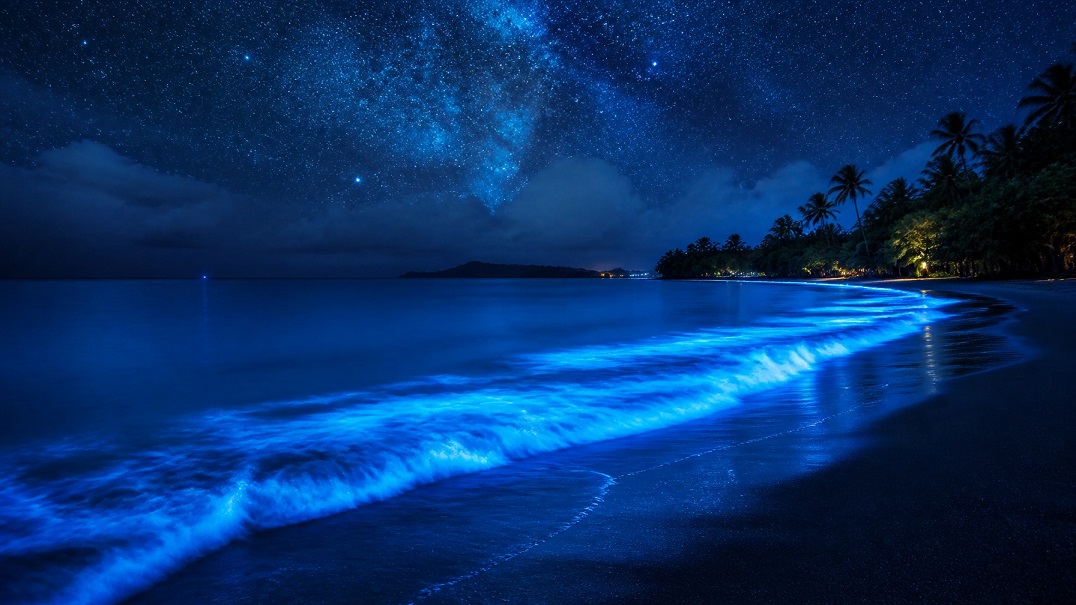
There’s a small handful of places on Earth where the ocean seems to light up on command. Wade into the water at night, drag a paddle through it, or just watch a wave break, and the water flashes electric blue, as if the entire bay is wired with tiny, invisible lights. It looks like something out of a movie, and understandably, a lot of people assume it has to be some kind of trick. It isn’t. It’s biology, and it comes down to the same broad category of organism that produces the DHA in an algae-based omega-3 supplement: algae.
This is one of the rare cases where “algae” points toward pure spectacle rather than nutrition, so consider this one purely for the fun of it.
The Organisms Behind the Glow
The blue glow in most bioluminescent bays comes from a type of single-celled marine plankton called dinoflagellates, the same broad group of organisms responsible for red tides, though in this case a different, non-toxic species is usually doing the work. In Puerto Rico’s famous bio bays, the species responsible is Pyrodinium bahamense, a name that translates roughly to “whirling fire,” which is a fairly accurate description of what happens when the water around it is disturbed.
These organisms are technically dinoflagellates rather than algae in the strictest sense, but they’re commonly grouped together with algae and phytoplankton, since many dinoflagellates, including this one, contain chlorophyll and are capable of photosynthesis, putting them in the same broad ecological category as the microalgae discussed elsewhere on this site.
Why the Glow Happens at All
The mechanism is a chemical reaction. These organisms contain a light-producing compound called luciferin, which reacts with oxygen, triggered by an enzyme called luciferase, to release a burst of blue-green light. It’s the same basic type of chemistry that makes fireflies glow, just running inside a single-celled organism drifting in salt water instead of an insect. Physical disturbance, like a wave breaking, a fish swimming past, or a paddle moving through the water, is usually what triggers the reaction, which is why the effect looks like it’s responding directly to motion.
Why It Might Exist in the First Place
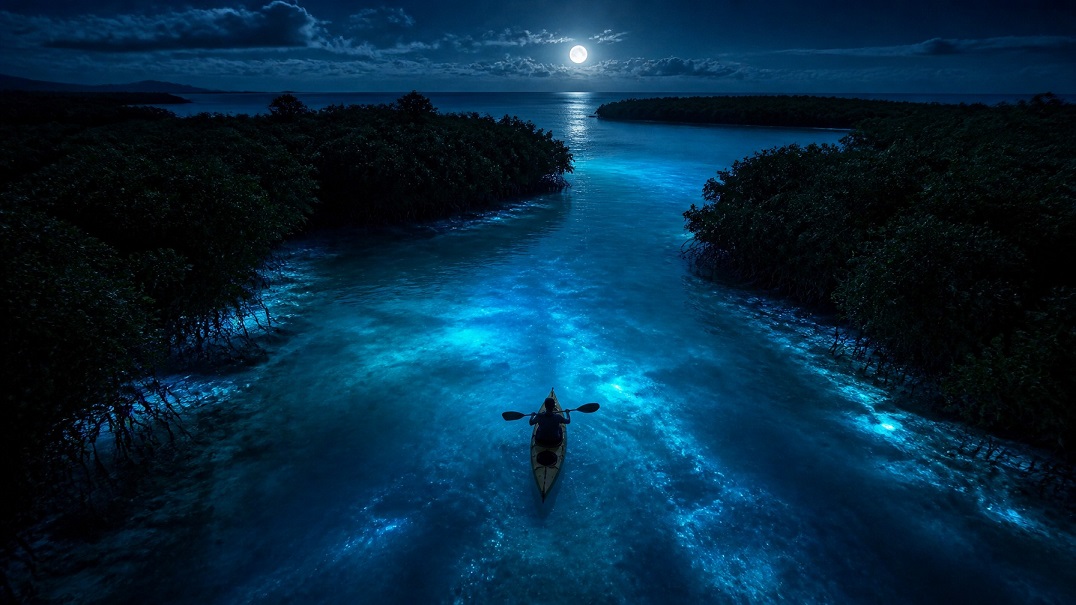
Researchers generally believe the glow serves as a defense mechanism, sometimes described as a “burglar alarm” strategy. A sudden flash of light can startle a small predator about to eat the dinoflagellate, or, in a stranger twist, it can actually draw the attention of a larger predator toward whatever disturbed the water in the first place, indirectly putting the original threat at risk. Either way, the light isn’t decorative. It’s a survival tactic that happens to look spectacular from a kayak.
Where to Actually See This
Bioluminescent bays are genuinely rare. Fewer than twenty are known to exist anywhere in the world, since the phenomenon depends on a fairly specific set of conditions: warm, shallow, nutrient-rich water, a narrow entrance that traps the organisms inside rather than letting them disperse into open ocean, and minimal light pollution to actually see the glow.
Puerto Rico’s Bio Bays
Puerto Rico is home to three of the world’s bioluminescent bays, and Mosquito Bay in Vieques is widely regarded as the brightest bioluminescent bay on the planet, once recognized by Guinness World Records for that distinction. Concentrations of dinoflagellates there have been recorded far higher than in most other bio bays, aided by a small, S-shaped entrance that keeps the organisms trapped inside and surrounding mangrove forests that continuously feed the bay with nutrients.
Beyond Puerto Rico
Similar phenomena have been documented in a small number of other locations around the world, including Luminous Lagoon in Jamaica and Halong Bay in Vietnam. A separate but related bioluminescent phenomenon, sometimes called the “Sea of Stars,” has also been documented along beaches in the Maldives, where breaking waves glow blue at the shoreline after dark.
The Connection Back to Everyday Algae
It’s a strange bit of context, but worth sitting with: the same broad category of ocean organism responsible for one of the most visually spectacular natural phenomena on the planet also happens to include some of the most nutritionally important organisms in the ocean, the ones ultimately responsible for the DHA and EPA that move up the marine food chain. Algae and its close relatives don’t do just one thing. Depending on the species, the same basic category of organism can light up a bay, tint the water red during a harmful bloom, or quietly produce the fatty acids fish depend on. It’s an unusually versatile branch of the tree of life for something most people never think about at all.

Frequently Asked Questions
What causes the ocean to glow blue at night?
The glow is caused by bioluminescent dinoflagellates, single-celled marine organisms that produce light through a chemical reaction between a compound called luciferin and oxygen, triggered by the enzyme luciferase. Physical disturbance in the water, like a wave or a paddle stroke, typically triggers the reaction.
Where is the brightest bioluminescent bay in the world?
Mosquito Bay in Vieques, Puerto Rico, is widely considered the brightest bioluminescent bay in the world, due to its exceptionally high concentration of the dinoflagellate Pyrodinium bahamense and a bay shape that traps the organisms inside.
Is bioluminescent algae dangerous?
The species responsible for bioluminescence in Puerto Rico’s bays, Pyrodinium bahamense, is generally considered non-toxic in that context, and the bays are safe to swim in where permitted. Some related dinoflagellate species can produce toxins under certain conditions, similar to the organisms responsible for red tides.
Why do dinoflagellates glow when the water is disturbed?
Researchers believe the glow functions as a defense mechanism, startling small predators or drawing the attention of larger predators toward whatever disturbed the organism, indirectly helping the dinoflagellate avoid being eaten.


