
Algae has a weird relationship with pop culture. It shows up constantly as shorthand for something gross, primitive, or vaguely apocalyptic, and yet it also keeps popping up as the answer to some of science fiction’s biggest survival problems, feeding astronauts, sustaining space colonies, keeping a dying civilization alive. It’s rarely the hero and rarely a simple background detail either. It’s the organism writers reach for whenever a story needs something that sounds both futuristic and faintly unsettling.
Here’s a tour through some of the strangest and most misunderstood algae moments in pop culture, including one persistent myth almost everyone gets slightly wrong.
The Soylent Green Myth Everyone Gets Backwards
If you ask most people what “Soylent Green” is, they’ll confidently tell you it’s made of algae or plankton. That’s actually the opposite of the movie’s entire twist. In the 1973 film, set in an overpopulated, ecologically collapsed version of 2022, a corporation sells a food product called Soylent Green to the public, marketed as being made from “high-energy plankton.” The film’s shocking final revelation, delivered in one of cinema’s most quoted lines, is that the ocean’s plankton has actually died off entirely, and the corporation has been secretly manufacturing the food from processed human remains instead.
In other words, the movie’s entire horror hinges on plankton, algae’s close relative in the popular imagination, being the reassuring lie, not the disturbing truth. The wafer wasn’t secretly algae. It was never algae at all. Somewhere in the decades since, popular memory flattened that distinction, and a lot of people now associate the phrase “Soylent Green” with algae itself rather than with the absence of it.
A Real Company Borrowed the Name
The connection gets a little more tangled thanks to Soylent, the real meal-replacement drink brand launched in the 2010s. According to its founders, the name is a nod to the same 1966 novel that inspired the film, not to the film’s grim plot twist, though the association understandably raises eyebrows among people who only know the movie’s famous final line. The real product, unlike its fictional namesake, doesn’t hide any dark secrets about its ingredient list.
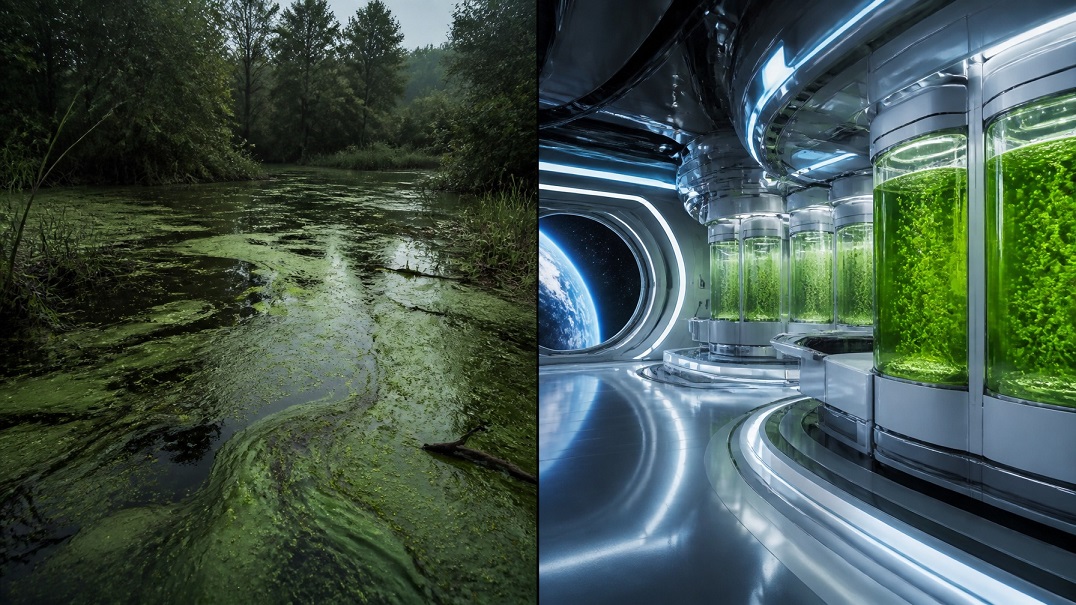
Algae as Science Fiction’s Go-To Survival Food
Long before Soylent Green scrambled the public’s understanding of plankton, and long after it, science fiction has repeatedly reached for algae as the plausible answer to a very real engineering question: how do you feed people in a closed environment with no fresh air, no soil, and no room for livestock? Algae photosynthesizes efficiently, grows fast, and can theoretically double as a source of both food and oxygen, which makes it a recurring feature of fictional space stations, generation ships, and off-world colonies.
What makes this particular trope unusual is that it isn’t really speculative at all. It’s grounded in genuine research. NASA actually studied microalgae in the 1980s as part of a real program investigating closed-loop life support for long-duration space missions, research that, through an unusual turn of events, eventually led to the algae-derived DHA now found in infant formula and omega-3 supplements. Science fiction didn’t invent the idea of algae as space food. It borrowed it directly from an actual government research program and dramatized it.
Why “Pond Scum” Became an Insult
Outside of science fiction, algae has picked up a much less flattering reputation as a general-purpose insult. Calling someone “pond scum” is shorthand for calling them low, contemptible, and beneath consideration, and the phrase leans entirely on algae’s visual reputation: the slimy green film that collects on the surface of still, stagnant water. It’s not hard to see why the phrase caught on. Algae blooms on a neglected pond are one of the most universally recognizable symbols of neglect and decay, an easy, visceral image for a writer or an angry person to reach for.
It’s a strange contrast, appearing in the same general cultural conversation as scientists earnestly proposing algae as the key to feeding astronauts. The same organism gets cast as both the villain’s insult of choice and civilization’s backup food plan, sometimes within the same decade of pop culture.
The Gap Between the Myth and the Microorganism
Strip away the movie mix-ups and the insults, and what’s left is a genuinely interesting organism that has spent decades doing quiet, unglamorous work while pop culture used it as a stand-in for everything from apocalyptic dread to futuristic salvation. The algae species actually cultivated for nutrition today, things like Schizochytrium and Crypthecodinium cohnii, have nothing to do with a fictional food conspiracy and nothing to do with a stagnant pond. They’re grown deliberately, in clean, controlled conditions, specifically because of what they can produce.
Pop culture will probably keep reaching for algae as a symbol, in one direction or the other, because it’s genuinely useful shorthand. It just rarely bothers to get the biology right along the way.

Frequently Asked Questions
Was Soylent Green actually made of algae?
No. In the 1973 film, Soylent Green was marketed to the public as being made from “high-energy plankton,” but the film’s twist reveals it was actually made from processed human remains after the ocean’s plankton had died off. The algae or plankton connection was the fictional company’s cover story, not the truth.
Is the real Soylent brand connected to the movie’s plot?
According to its founders, the name of the real Soylent meal-replacement brand is a reference to the 1966 novel “Make Room! Make Room!,” which the film Soylent Green was loosely based on, rather than a reference to the film’s human-remains plot twist.
Did NASA really research algae as a food source for astronauts?
Yes. In the 1980s, NASA funded research into microalgae as part of a closed-loop life support program for potential long-duration space missions. That research eventually led to the discovery of algae strains now used to produce DHA for infant formula and omega-3 supplements.
Where does the insult “pond scum” come from?
The phrase draws on the common appearance of algae blooms forming a slimy green film on the surface of stagnant water, using that visual as shorthand for something low, neglected, or contemptible.


