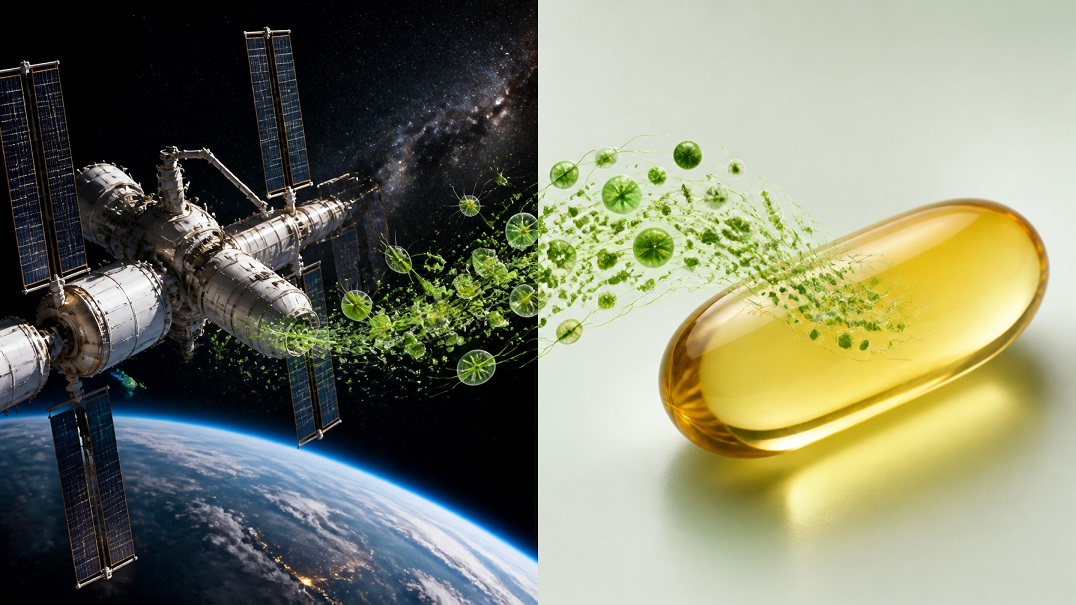
If you take an algae-based omega-3 supplement, you’re swallowing a small piece of space history. The strain of algae that makes the DHA in your softgel wasn’t discovered by a supplement company hunting for the next big ingredient. It was studied by aerospace engineers trying to solve a much bigger problem: how to keep human beings alive on a spacecraft for months or years at a time, with no way to restock the pantry.
The path from “how do we feed astronauts on a trip to Mars” to “here’s your daily DHA capsule” took about a decade, a canceled space program, and six scientists who refused to let their research die with it. It’s a strange, mostly untold story, and it explains a lot about why algae oil exists as a consumer product at all.
A NASA Program Built to Solve the Astronaut Food Problem
In the early 1980s, NASA was already thinking well past the space shuttle. Long-duration missions, the kind that might last years rather than days, come with a logistics problem that short trips don’t: you can’t just pack enough food, water, and oxygen for the whole journey. At some point, the spacecraft has to become its own miniature ecosystem.
NASA’s answer was a research effort called the Closed Environment Life Support System program, or CELSS. The idea was to build a self-sustaining loop where plants, or in this case microorganisms, could recycle waste, generate oxygen, and produce food, all without shipments from Earth. NASA contracted this work out to Martin Marietta, a major aerospace company, whose scientists began experimenting with microalgae as a candidate.
Why Algae Made Sense for a Spacecraft
Algae turned out to be a strangely good fit for the job. It grows fast, it doesn’t need soil, it can photosynthesize under artificial light, and different strains produce wildly different compounds, some of which are nutritionally valuable to humans. For a program trying to build a life support system out of biology instead of machinery, algae was a promising building block.
The scientists at Martin Marietta spent years testing different algae strains for the CELSS program, cataloging what each one produced and how efficiently it grew. This wasn’t glamorous work. It was the kind of patient, unglamorous cataloging that rarely makes headlines, right up until it accidentally does.
Six Scientists Walk Away From a Dying Program With a Box of Algae
In 1985, Martin Marietta made a business decision that had nothing to do with the science: the company decided to get out of bioscience research entirely and shut down its involvement with CELSS. For most corporate research programs, that would have been the end of the story. The algae strains would have gone back in a freezer somewhere and been forgotten.
Instead, six of the scientists who had spent years studying those algae strains left the company and started their own. They called it Martek, which happened to be the name of the internal division they had worked in at Martin Marietta. They didn’t have a business plan built around infant nutrition or dietary supplements. They had a hunch that the algae they’d been studying for astronauts might be useful for people who were never going to leave Earth.

The Discovery That Turned Space Research Into Baby Formula
The breakthrough came when Martek’s researchers zeroed in on a marine microalgae species called Crypthecodinium cohnii. It turned out to be an unusually efficient natural producer of DHA, the same omega-3 fatty acid that shows up constantly in brain and eye health research today.
At the time, DHA was already known to be important. It’s abundant in human breast milk and plays a major role in early brain and eye development. The problem was that infant formula in the 1980s didn’t contain it. Formula manufacturers had no practical, scalable source of DHA to add to their products, so they simply left it out.
Martek’s algae solved that supply problem. The company developed a product called Formulaid, an algae-derived source of DHA (paired with ARA, an omega-6 fatty acid made by fermenting a soil fungus) that could be blended into infant formula. Within about a decade, it had become standard. Formulas containing Martek’s algae-derived DHA now reach the overwhelming majority of infant formula sold in the United States and are used in dozens of countries around the world.
An algae strain that NASA funded for a Mars mission that never happened ended up in the diets of tens of millions of babies instead.
From Infant Formula to the Supplement Aisle
Formula was just the beginning. Once Martek had proven that algae-derived DHA could be produced at commercial scale, the same underlying idea, growing algae in controlled fermentation tanks and extracting the oil, opened the door to a much wider range of products.
The company later commercialized a second algae strain, Schizochytrium, which is now one of the most common sources of DHA in adult omega-3 supplements, including many algae-based products on the market today. The production process has been refined considerably since the 1980s, but the core concept is the same one that came out of the CELSS program: grow algae in a controlled environment, and let it do what it already does in the ocean, produce omega-3 fatty acids, without needing a fish anywhere in the chain.
Why This History Actually Matters to You
It’s a fun trivia fact that your supplement has a space program in its family tree, but it also explains something practical about why algae oil works as well as it does. Fish don’t generate their own omega-3s. They accumulate DHA and EPA by eating algae, directly or indirectly, further down the food chain. Algae is the actual source. Fish are just the delivery truck.
NASA’s research didn’t invent that fact, but it did prove, decades before “vegan omega-3” was a category anyone searched for online, that you could skip the fish and go straight to the source at industrial scale. The infrastructure that makes modern algae-based omega-3 supplements possible, the fermentation techniques, the strain selection, the extraction methods, traces directly back to a life support program that was originally trying to solve a much stranger problem than nutrition: how to keep people alive on the way to somewhere else.

Frequently Asked Questions
Did NASA actually create omega-3 supplements?
Not directly. NASA funded research into microalgae for use in closed-loop life support systems on long-duration space missions. That research was carried out by Martin Marietta scientists, who later left to found Martek Biosciences and commercialized the algae for infant formula and, eventually, dietary supplements.
What algae species is used in DHA supplements today?
Schizochytrium is one of the most widely used species in modern algae-based DHA supplements, along with Crypthecodinium cohnii, the strain originally identified through the NASA-funded research in the 1980s.
Why was algae studied for space travel in the first place?
NASA’s Closed Environment Life Support System (CELSS) program explored whether microorganisms like algae could help sustain astronauts on long missions by recycling waste, generating oxygen, and serving as a food source, reducing the need to carry all supplies from Earth.
Is algae-based DHA the same as what’s in fish oil?
Chemically, yes. DHA is DHA regardless of source. Fish accumulate their omega-3s by eating algae or smaller fish that ate algae, so algae-based supplements provide the same fatty acids at the original source in the food chain.


